Showing posts with label Stephen Berger. Show all posts

Wednesday, September 4, 2013

Christine Quinn, Jennifer Cunningham, Stephen Berger, and Hospital Closings

How did Stephen Berger get away with closing so many hospitals? The story begins like this ....

An excerpt from Chapter 9 of Roots of Betrayal : The Ethics of Christine Quinn, available now for a free preview on Scribd :

The hospital closings called for by the Berger Commission were formulated at a time when only some hospital patients were covered by job-based health insurance, and hospitals were forced to write down the economic costs from treating underinsured and uninsured patients. The Berger Commission, headed by a Wall Street banker, Stephen Berger, was only capable of seeing the provision of full-service hospital care from perspective of profits, losses, and debts, instead of from the perspective of providing people with the human right to healthcare. “We have a history in this state of pumping money into the system and not letting hospitals close even if they should,” Mr. Berger told The New York Times, adding, “You have to right-size the system, you have to shrink it, that is No. 1.” In typical Wall Street fashion of divorcing any moral dilemma from situational ethics, hospital closings were pushed as inevitable, and patients were expected to have to deal with it. This was about a decade before "Obamacare" would extend healthcare coverage to millions of uninsured Americans. Back then, Mr. Berger observed overcapacity among hospitals, which had to be cut. However, in the future, Mr. Berger’s draconian cuts would prove to gut healthcare infrastructure leading up to the time when Obamacare would lead to a large influx of newly covered healthcare patients. But even without knowing that healthcare coverage would be expanded within the next decade, back then healthcare advocates knew about the dangers of past outbreaks, pandemics, and unforeseen uses of bioterrorism agents, such as anthrax. There were reasons why it was penny wise and dollar foolish to make drastic cuts to full-service hospital capacity in New York City.

One healthcare union, 1199/S.E.I.U., had to scramble to deal with the fallout over job losses from the impending hospital closings. Jennifer Cunningham, who at that time worked as a spokesperson and political operative for 1199 and would later go on to work for Christine as a political campaign consultant, was more concerned at the time about employee retraining and not about the interruption of patient-centered care. The hit list of hospitals that would be targeted for closure by the Berger Commission came to be known as the Berger Commission Report, and Christine, as chair of the City Council Health Committee, was largely absent from the initial public conversation in 2004 and 2005 around Mr. Berger’s recommendation for hospital closings. Taking her cue from former Speaker Gifford Miller’s precedent of maintaining silence on the controversial West Side Stadium until the project’s outcome was clear, Christine was not visible in the resistance movement to fight the Berger Commission Report’s recommendations until very late in 2006, when the City Council issued its own report just weeks before the Berger Commission Report’s final recommendations would go into effect on January 1, 2007.

Read more : Roots of Betrayal : The Ethics of Christine Quinn, available now for a free preview on Scribd.

Wednesday, July 10, 2013

SUNY officials order police to arrest activists trying to save LICH from closure

BREAKING : Bill de Blasio Was Arrested in an Act of Civil Disobedience to Save LICH.

New York City public advocate Bill de Blasio was led away in handcuffs after reports that a peaceful demonstration to save Long Island College Hospital from closing turned into an act of civil disobedience.

A demonstration had been scheduled Wednesday morning to apply political pressure on SUNY management officials. SUNY will decide whether LICH remains open or is closed as part of Gov. Andrew Cuomo's radical healthcare cuts to window dress the New York State budget in advance of his expected bid for the 2016 presidential race.

Healthcare activists, hospital employees, and healthcare union officials have been trying for months to appeal for help from politicians from Albany to City Hall, but the state legislative session ended last month with no rescue package, and locally Mayor Michael Bloomberg and New York City Council Speaker Christine Quinn concluded next years budget negotiations without making any provision to save LICH from closure.

In the last few weeks, activists had been holding many demonstrations, rallies, and other acts of protest to draw attention to the plight of Brooklyn hospitals. Since 2006, ten New York City hospitals have either closed or downsized, and the remaining hospitals are over-burnded. Wait times at emergency rooms are escalating, and patients in life-or-death situations are having to take longer and longer ambulance rides to get to the next nearest emergency room. To make matters worse, Gov. Cuomo empaneled a group called the Medicaid Redesign Team to identify three more hospitals to close in Brooklyn.

On Feb. 8, 2011, four community activists were arrested in an act of civil disobedience to save St. Vincent's Hospital, but the community received no support from Speaker Quinn. At a rally outside of Gov. Cuomo's office on Monday, Mr. de Blasio accused Mayor Bloomberg of just walking away from the community after St. Vincent's Hospital closed. St. Vincent's activists don't remember Mr. de Blasio being involved in the herculean effort to first save St. Vincent's and then to later preserve the hospital infrastructure for a replacement hospital. But pressure politics from this year's mayoral campaign season has finally pushed him to take bold action. Many St. Vincent's activists noted that it was about time that Mr. de Blasio took action, after all, he is the city's Public Advocate.

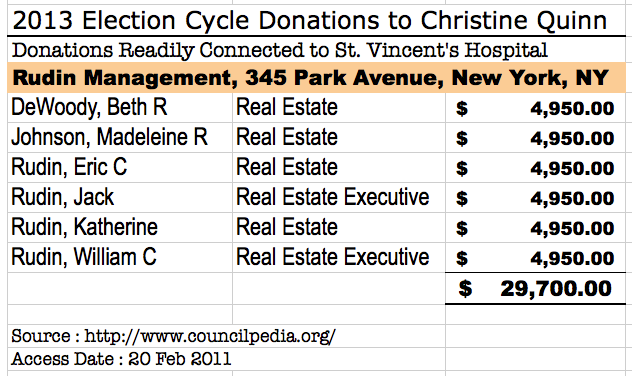
Speaker Quinn accepted $30,000 in campaign donations from Rudin Management Company before she approved the billion-dollar Rudin condo conversion plan for St. Vincent's Hospital.

Tuesday, April 2, 2013

Did Christine Quinn Have A Quid Pro Quo Deal With The Rudin Family In Respect Of The St. Vincent's Luxury Condo Conversion Plan ?

In exchange for $30,000 in campaign donations, did New York City Council Speaker Christine Quinn sell out her community ?

In this YouTube video, bloggers confront New York City Council Speaker Christine Quinn about the closing of St. Vincent's Hospital and the influence of $30,000 in campaign donations made by the Rudin family.

Christine Quinn,Rudin Family,Rudin Management,Mayor 2013 NYC,Campaign Donations,Real Estate Deals,Hospital Closings,St. Vincent's Hospital

In an apparent conflict of interest, Beth R. DeWoody, Madeleine R. Johnson, Eric C. Rudin, Jack Rudin, Katherine Rudin, and William C. Rudin each donated $4,950 to Christine Quinn's presumed 2013 mayoral campaign. Since 2010, the Rudin family has been trying to get approval for a billion-dollar real estate development plan for the buildings that belong to the bankruptcy estate of St. Vincent's Hospital. Since the Rudin family wants to build luxury high-rise condos on the site of St. Vincent's, and since they needed City Council approval from Speaker Quinn, do these large campaign donations explain why Speaker Quinn did nothing to restore a Level I trauma center and full-service hospital to the former St. Vincent's site ? Does Speaker Quinn's official acts come as a result of sizable campaign donations from the likes of the Rudin family ?

Sunday, December 2, 2012

Interfaith To File For Bankruptcy, May Become Tenth Hospital To Close Under Christine Quinn

Related : J31 Rally to Save Interfaith and LICH outside Gov. Cuomo's Office - Stop Hospital Closings

Interfaith Medical Center Plans To Declare Bankruptcy This Week.

Gov. Andrew Cuomo empaneled a consulting group called the Medicaid Redesign Team headed by investment banker Stephen Berger. The last consulting group headed by Mr. Berger came to be known as the Berger Commission. The tasks of both groups was the same : to identify hospitals to close down, so that New York State could implement cuts to the state's healthcare budget.

In the latest development, it was announced today that Interfaith Medical Center in Brooklyn plans to file for bankruptcy. The Medicaid Redesign Team has identified three hospitals in Brooklyn, which serve uninsured and underinsured patients for closing ; one of these was Interfaith.

How the Cuomo administration plans to carry out the closings is to merge the financially unstable hospitals together in some combinations, so that that the hospitals can hemorrhage money faster, so that they can end up collapsing under the weight of their combined debts.

Interfaith officials told The New York Times that turning over operational control to Brooklyn Hospital without the state’s first promising the financing needed to keep Interfaith going would be tantamount to a covert plan to close Interfaith in a year and a half or so.

A similar money-losing arrangement was made between a string of hospitals lead by St. Vincent's, which lead to the financial collapse of each hospital : St. Vincent's, St. Johns Queens Hospital, and Mary Immaculate Hospital.

Because the Medicaid Redesign Team's sole purpose has been to make even deeper cuts to the state's healthcare budget, Gov. Cuomo's austerity plan is responsible for the bankruptcy filing. In letters to state officials, Nathan M. Barotz, the chairman of Interfaith's board of trustees, has said that a 2010 cut in Medicaid reïmbursement rates cost Interfaith 40 percent of its inpatient revenue and precipitated its current crisis.

In the aftermath of Hurricane Sandy, so many New York City hospitals endured damage. There is a shortage of functioning hospitals right now.

One hospital executive, Michael Dowling, is trying to profit from the disaster that Hurricane Sandy has caused to his competition. Mr. Dowling is head of the parent-holding company of Lenox Hill Hospital. Mr. Dowling opposes opening anymore hospitals, because Lenox Hill Hospital is now making record amounts of money from an influx of patients from the damaged hospitals with which he competes.

NYU Langone Hospital, Bellevue Hospital, and Coney Island Hospital were evaucated after each hospital suffered damage and power failures. None of these hospitals have been able to return to 100% functioning levels. How can it make sense for Gov. Cuomo to keep forcing hospitals to close ?

Related : With Some Hospitals Closed After Hurricane, E.R.’s at Others Overflow

If Interfaith does indeed close, it will become the tenth hospital to close since Christine Quinn became speaker of the New York City Council in 2006.

Wednesday, May 2, 2012

Healthcare is Election Issue

On May Day Healthcare for the 99% and members of the community march from St Vincent's Hospital to Union Square.

In the face of public healthcare budget cuts and irresponsible and dangerous hospital closings, activists are organizing around the idea that a truly universal, single-payer healthcare system is the only viable option that will provide healthcare for all. Listen to the march participants chant, "Healthcare is a Human Right! Medicare For All!"

Thursday, April 12, 2012

Berger Attacks SUNY Downstate

--

Stephen Berger decides which hospitals will close in Brooklyn, and he serves at the pleasure of Gov. Andrew Cuomo. Call Gov. Cuomo @ (518) 474-8390 and tell him : (i) to fire Stephen Berger, and (ii) that we need universal healthcare for all.

From The Brooklyn Eagle :

BROOKLYN -- Several hundred Occupy Wall Street (OWS) activists -- accompanied by a phalanx of NYPD officers -- marched across the Brooklyn Bridge and rallied in Cadman Plaza Park in Brooklyn Sunday afternoon, marking six months since hundreds of them were arrested on the bridge.

Spirits were high and the music was spirited, but the theme of the anniversary march was sobering -- the dire state of health care for Brooklyn residents, especially those served by five hospitals in crisis: Brooklyn Hospital Center, Interfaith Medical Center, Wyckoff Heights Medical Center, Brookdale University Hospital and Medical Center, and Kingsbrook Jewish Medical Center.

Wall Street financier Stephen Berger, appointed by Gov. Cuomo to be in charge of restructuring health care in Brooklyn, is recommending that New York change its laws “to allow for-profit investors to invest in financially-distressed public hospitals.”

The group criticized Berger’s plan to close SUNY Downstate's inpatient services and move them to SUNY LICH in Cobble Hill, leaving thousands of central Brooklyn residents without health care services – a plan rejected by SUNY Downstate President John LaRosa. They also criticized his push to close Kingsboro Psychiatric Center and move its services to Staten Island -- a plan that was canceled Friday after Brooklyn legislators interceded on Kingsboro’s behalf.

Berger also blocked an effort to include an emergency room at SUNY Downstate at Bay Ridge. ...